Showing posts with label simple. Show all posts

Saturday, 2 January 2016

December Index Fund Performance

A quick follow up post to my original on My Experiences with the Concept of Dollar Cost Averaging and my current continual investment in the Vanguard Australian Shares Index Fund.

This month in December the fund had improved performance compared to the month of November.
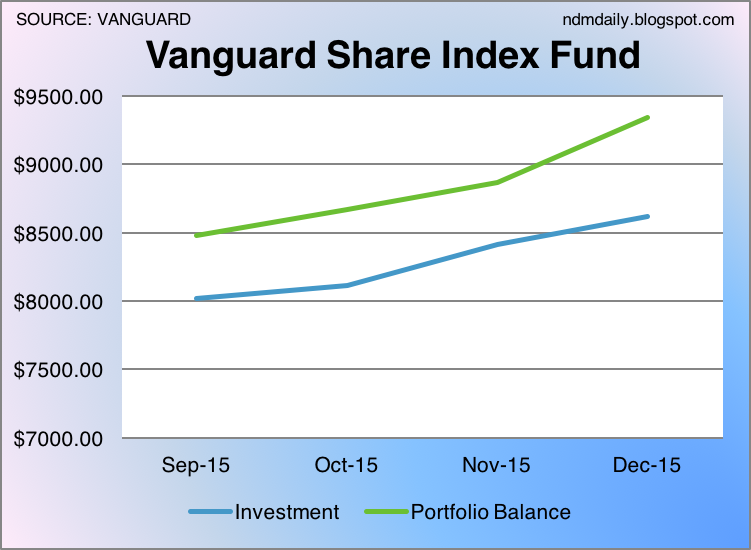


A nice rally to end of the year as shown in the graph above and slowly starting to creep up to the starting balance of 2015. Essentially saying the ASX 300 went no where but with dividends I've still managed a decent rate of return for an investment that I'm only sitting back and providing automated payments. With the rate of return now climbing to below 10% for the first time, perhaps the dollar average investment approach one is starting to pay off. I'll be interested to see what happens over the next year in 2016 and if the "end of the GFC" for the US market has any affect on the performance of this investment. The rate hike occurred on the 17th of December and as shown below there was a substantial reaction from the market.


I'll continue to update this on a monthly period to see whether the whole concept of investing into an index fund long term at regular intervals works.


Sunday, 15 November 2015

80/20 Principle

Currently I am reading a book about the 80/20 Principle and it's application in a business and financial sense but it makes me wonder how it would be applicable for weight loss and general fitness.

I am someone who has planned my meals Monday to Thursday with Friday being a bit loose as I usually go out for lunch at work and then from there on things start to slip on weekends. Unfortunately this probably does more damage than I am able to recover during the week Monday to Friday. The 80/20 principle states that 20% of your effort has 80% of the effect, this case the "20%" of the weekend has the effect of 80% of my diet as usually the calorie intake and output is much higher than what I'm able to achieve during the week. This essentially means we shouldn't be worrying so much during the week, the fact we are at work we are able to easily perform routine health and fitness activities and it's during the weekend that we should be focussing 80% of your effort.

During our health and fitness adventures we should celebrate those moments we are achieved something remarkable such as achieving your first 5km in 10 years or reaching a goal weight you had not been at for many years. Instead of focussing on the average achievements we are able to gain a lot more from celebrating the bigger achievements which took more effort but had a bigger net positive result.

A successful fitness plan is a simple fitness plan where individuals are able to take short cuts to achieve more with less effort. A simple "short cut" could be planning your meals for the weekend rather than thinking on the fly. By having a fitness plan we are able to exercise control over our lives with the least possible effort because the planning of our weeks allows us to act with minimal thought.

By focussing on weekends primarily we are able to strive for excellence in the time that counts most, spending more time worrying about the weekday health and fitness won't result in anywhere near the same positive results for you.

We should look for help as much as possible, by out sourcing certain tasks such as exercise (personal training) or food (youfoodz/light n easy) we are able to remove further stress from our lives in not having to think about those certain elements in our health and fitness plan.

More importantly, our health and fitness plans should have things that we enjoy. There is no point eating stacks of fish if you don't like fish.

Finally we must enjoy the journey. We must calm down, work in an efficient manner (what's the point of exercising every day?!) and set a limited number of valuable goals where the 80/20 principle will work for us. An example of a very simple goal could be, on weekends I will only have one bad meal on Saturday. By focussing on the areas where we slip up most we are able to negate the most damaging aspects of our lives. Health and fitness shouldn't be a chore, it's something fun and it's only when one has fun is where they will see their results compound. Treating it as a chore will get you no where as you will constantly find ways to have a negative perspective on your journey.

Monday, 26 October 2015

Monday Motivation

State of Mind

If you think you are beaten, you are,
If you think you dare not, you don't
If you like to win, but you think you can't,
It is almost certain you won't.

If you think you'll lose, you're lost
For out of the world we find,
Success begins with a person's will -
It's all in the state of mind.

If you think you are outclassed, you are,
You've got to think high to rise.
You've got to be sure of yourself before
You can ever win a prize.

Life's battles don't always go
To the stronger or faster man
But soon or late the one who wins
Is the who thinks he can.

By Napeleon Hill

Saturday, 24 October 2015

The Power of Desire

I am currently reading the book Think and Grow Rich by Napoleon Hill which thus far has been a very interesting read regarding the mindset of those who become wealthy but I also believe many of the principles that I've read in the book can applied to ones health and fitness.

For instance one the chapter talks about desire and how important it is for those wishing to accomplish specific goals in life to maintain a high standard of desire. The method applies to becoming rich however I have altered it to show how it can be applied for health and fitness and is now something I wish to use going forward in a subconscious manner.

  1. Fix in your mind the exact weight and lifestyle you desire. It is not sufficient merely to say, "I want to be skinny." Be definite as to the amount.
  2. Determine exactly what you intend to give in return for the body you desire.
  3. Establish a definite date when you intend to possess the body you desire.
  4. Create a finite plan for carrying out your desire, and begin at once, whether you are ready or not, to put this plan into action.
  5. Write out a clear, concise statement of the body weight you intend to reach. Name the time limit for its acquisition. State what you intend to give in return for the body, and describe clearly the plan through which you intend to reach it.
  6. Read your written statement aloud, twice daily, once before retiring at night, and once before rising in the morning. As you read, see and feel and believe yourself in your new body and lifestyle.
The problem with the health and fitness industry these days is everything is has become far too complicated with too many fad products and effective marketing confusing the masses of population to take shortcuts and forget about the basics of being a health and active person. Whilst people argue over calorie counting and macro nutrients and so on, the simple truth is the person will not succeed if their mindset is not in the right space. Using the method above is step towards reaching your goal, by reminding yourself twice daily you can hope to turn basic diet controls such as calorie awareness and portion control into habits done purely based on your subconscious.

Sunday, 11 October 2015

Listed Investment Company Dollar Cost Averaging Investing Approach

Today I looked at appropriate methods on Dollar Cost Averaging Investing on Listed Investment Companies (LICs) and limiting the impact of brokerage and ensuring I can achieve regular payment intervals.

I reviewed five LICs and compared their performance with a trial investment strategy which I hope to implement in the near future:


1 Year 2 years 3 Year 5 Year 10 Year 15 Years 30 years
BKI
7.3

20.5
15.7
11.8


AFI
0

15.2
9.5
8.4


ARG
6.6

15.5
9.8
7


MLT
3.2

18.9
12.1
8
11.1

WHF
21.17
19.42
23.05


12.28

Plotting a very simplistic approach to the strategy I assumed that for the first five years I'd aim to save $50 a week, $100 a week for the next five years and then $150 a week from there after up to 40 years. I assumed an initial deposit of $2000 and the graph below does not consider brokerage costs and assumes that the amount deposited goes straight into the investment. The results were as follows:


Obviously this best case scenario as the investment is far from accurate but does show the intensity of compounding effects over the long term.

This lead to my original thought, how does one use an LIC investment product with a Dollar Cost Averaging investment approach.

I came across a method conceptualised by a user named Codebeard at the Stackexchange.com forums who was able to provide a formula for the optimum investment time given the investment amount, deposit intervals, annual interest on bank account, expected annual growth of stock and brokerage per trade. The formula then gives you a number of deposit intervals to save prior to investing. 

Information of the approach can be found here.

The plan from here is to invest in BKI and AFI LIC shares at $50 a week initially storing money in my Netbank saving account with a low interest rate of 2.5% and an annual growth of the stock as shown above gives me a time period of 16 weeks for my deposit amounts. I have also chosen these two LICs as they performed the best when the market was in downturn and as shown in the graph above they have performed very reasonably.

The process is now under way and I'll aim to update at the 16 week mark the purchase cost of the investment and provide updates from there on when I either invest in the shares or dividends and reinvested.

Saturday, 10 October 2015

My Experiences Concept of Dollar Cost Average Investing

One of the investment concepts I've been partaking in is the Dollar Cost Averaging Investing concept. The concept works great for someone who is after an automated and emotionless strategy. By buying into an investment product such as LIC or a managed fund with regular payments at regular intervals the investor is able to smooth out the anticipated market fluctuations over time. The investment strategy is one for the long term and with the use of automated payments can be an effective investment strategy with no great deal of thought required by the investor.

I have been using this strategy with the Vanguard Index Australian Shares Fund and below is a summary of its performance to date:

Initial Investment - $5000 @ $1.9023 per unit (10/12/2012)
Total Investment Deposits - $3401.72
Total Reinvestment Deposits - $518.71
Total Investment Payments - $8533.83
Actual Investment Value - $8476.04
Rate of Return - 0.67%

Not quite the result I was after but with franking credits my tax returns have been assisted with this fund in increasing my tax return. Also with over $500 worth of reinvestments into the fund, the rate of return calculated just with my money invested is 5.75%. All in all, a bit of a disappointing result so far but I'll stay the course given what the ASX300 index performance is like:


I'll continue to blog my portfolio performance at the end of month to track its progress. My next blog post will focus on a concept of Dollar Cost Averaging through buying shares at the optimum intervals.